
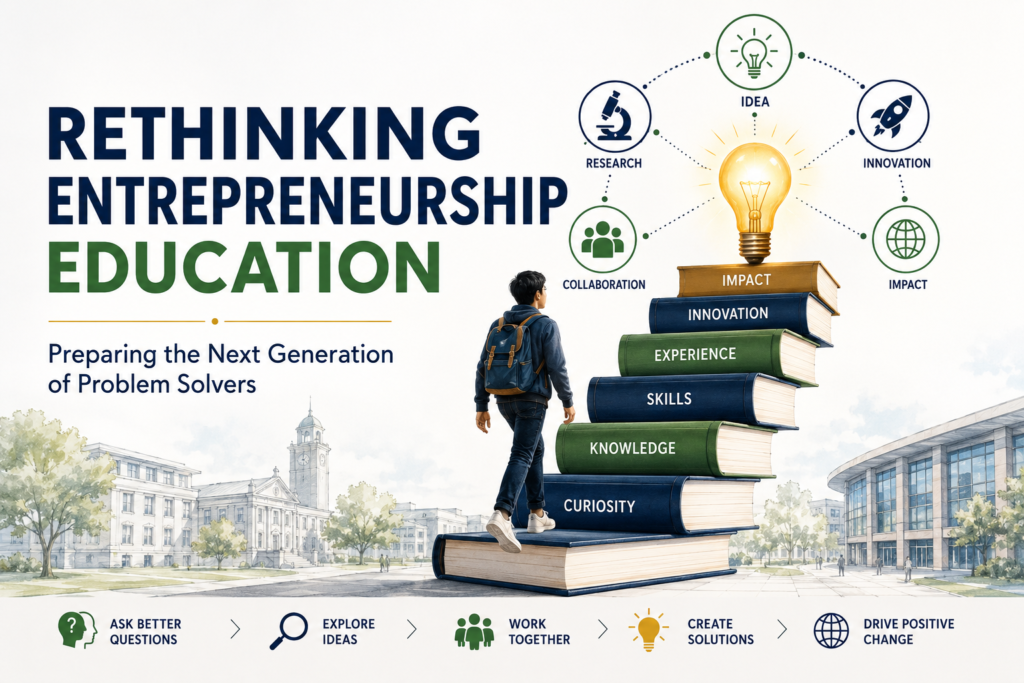
Entrepreneurship education should not only teach students how to build businesses. It should prepare them to solve meaningful problems.
Entrepreneurship has become one of the fastest-growing subjects in higher education. Universities around the world now offer entrepreneurship courses, startup competitions, incubators, and innovation programs. This is encouraging. Yet I often wonder whether we are focusing on the right outcome. Too often, entrepreneurship education is measured by the number of startups created after graduation. While business creation is important, it should not be the only measure of success. The real purpose of entrepreneurship education should be much broader. It should develop people who can recognize opportunities, solve problems, think creatively, and create value wherever they work.
Entrepreneurship Is a Mindset Before It Is a Business
Not every student will become a founder. Nor should they. Some will become researchers, engineers, teachers, healthcare professionals, policymakers, or community leaders. Yet all of them will face problems that require creativity, collaboration, and innovation. These are entrepreneurial skills. Teaching entrepreneurship should therefore begin with developing curiosity rather than teaching company registration. Students should learn how to ask better questions, identify unmet needs, test ideas, and learn from failure. Business creation may follow. But entrepreneurial thinking comes first.
Learning Beyond the Classroom
Entrepreneurship cannot be developed through lectures alone. Students learn entrepreneurship by doing. Working on real projects, collaborating with different disciplines, engaging with local businesses, and solving community challenges often teach more than textbooks alone. Universities should create environments where experimentation is encouraged and failure becomes part of the learning process rather than something to fear. These experiences help students develop confidence, adaptability, and resilience—qualities that remain valuable throughout their careers.
Connecting Education with the Real World
One of the greatest strengths of entrepreneurship education is its ability to connect universities with society. Students should have opportunities to work alongside entrepreneurs, researchers, industries, nonprofit organizations, and local communities. These partnerships expose students to real challenges while allowing universities to contribute practical solutions. Education becomes more meaningful when learning extends beyond the classroom. Knowledge becomes more valuable when it creates impact.
Preparing for an Uncertain Future
Technology is changing how we work, communicate, and innovate. Artificial intelligence, automation, climate challenges, and digital transformation will continue to reshape the future of work. Many of tomorrow’s jobs do not yet exist. Rather than preparing students for a single profession, entrepreneurship education should prepare them to adapt, learn continuously, and create opportunities in changing environments. In an uncertain world, entrepreneurial thinking may become one of the most important lifelong skills.
Entrepreneurship education should not be viewed as a program for a small group of future business owners. It should become part of a broader educational philosophy. Its purpose is not simply to create startups. Its purpose is to develop people who are curious enough to question existing systems, confident enough to test new ideas, and committed enough to create positive change in their communities. When education develops these qualities, entrepreneurship becomes more than an academic subject. It becomes a way of thinking.
The future does not simply need more entrepreneurs. It needs more people who can recognize opportunities, embrace innovation, and solve meaningful problems. Perhaps the greatest success of entrepreneurship education will not be measured by the number of companies it creates, but by the number of people it inspires to create positive change wherever they are.