
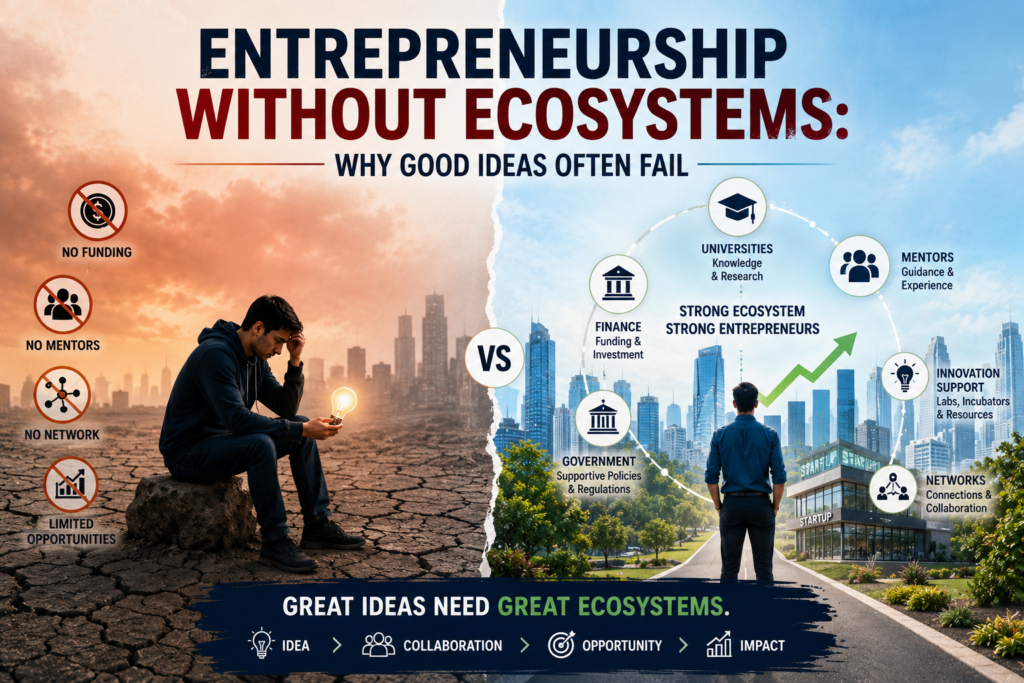
Great ideas are important. The environment surrounding those ideas is often even more important.
Is a Good Business Idea Enough?
Many aspiring entrepreneurs spend months refining their business ideas. They improve their products, prepare business plans, and search for customers. It is natural to believe that a better idea will automatically lead to a better business. Unfortunately, reality is rarely that simple. Around the world, countless promising ideas never become successful enterprises. At the same time, some seemingly ordinary ideas grow into thriving businesses.
Why?
The difference often lies beyond the idea itself. It lies in the ecosystem that surrounds it.
Entrepreneurs Do Not Operate Alone
Entrepreneurship is often described as an individual journey driven by passion, creativity, and determination. While these qualities matter, no entrepreneur succeeds entirely alone. Behind every growing business are people, institutions, and opportunities that quietly influence its success.
A mentor may provide critical advice.
A university may contribute research.
A financial institution may offer early funding.
Government policies may reduce barriers to innovation.
A supportive community may become the entrepreneur’s first customers.
These connections rarely make headlines, yet they often determine whether an idea survives or disappears.
The Missing Ingredient
Imagine two entrepreneurs with the same business idea. One has access to experienced mentors, professional networks, funding opportunities, university resources, and supportive local policies. The other works alone, struggles to access information, and has few opportunities to connect with people who can help.
Whose business is more likely to succeed?
Most of us would choose the first entrepreneur. If that is true, then success depends on more than the quality of an idea. It also depends on the quality of the environment in which that idea develops.
Ecosystems Create Opportunities
An entrepreneurial ecosystem is not a single organization. It is a network. Universities, investors, business associations, government agencies, researchers, entrepreneurs, and local communities each contribute something different. Individually, their impact may appear small. Together, they create an environment where ideas can be tested, improved, financed, and eventually transformed into sustainable businesses. Strong ecosystems do not guarantee success. But they significantly improve the chances that good ideas will have the opportunity to succeed.
Building Better Ecosystems
Many governments focus on encouraging people to start businesses. That is important. However, encouraging entrepreneurship without strengthening the surrounding ecosystem is like planting seeds without preparing the soil. Entrepreneurship policies should therefore extend beyond startup funding. They should also invest in entrepreneurship education, research, mentorship, university–industry collaboration, innovation support, and community networks. Developing entrepreneurs and developing entrepreneurial ecosystems should happen together. One cannot reach its full potential without the other.
Successful businesses rarely grow because of ideas alone. They grow because ideas meet the right environment at the right time. Perhaps the future of entrepreneurship depends less on discovering better ideas and more on building better ecosystems. After all, good ideas create possibilities-but strong ecosystems create opportunities for those possibilities to become reality.